
Using the Pace Clock: The Skill Every Swimmer Needs to Master
Updated: Sep 10
Parent Guide Series - Updated September 2026
The pace clock is a fundamental training tool in swimming. It gives swimmers and coaches a shared reference for start times, swim times and recovery.
For a young swimmer, leaving on the correct number and remembering where the hand was at the start is progress. Calculating times and helping organise the lane come with practice.

How to Read It
This guide explains the analogue pace clock. Its hand travels clockwise, completing one full turn every 60s.
Position | Reading |
Top | :00, sometimes marked 60 |
Right, quarter | :15 |
Bottom, half | :30 |
Left, three-quarters | :45 |
For swimmers used to digital displays, the moving hand can feel unfamiliar. Reading it and working out elapsed time involve timing and basic maths, practised alongside swimming technique.
Remember your start point and keep track of whole minutes.
For a swim lasting less than a minute, starting on :10 and finishing on :52 gives a time of 42s. On a longer swim, those same positions could represent 1:42.
Red and Black Hands
Many pace clocks have red and black hands opposite each other, 30s apart. Follow the hand your coach names and use the same colour to check your finish.
A coach may use the other hand when changing a start or allowing extra recovery. Follow the instruction rather than assuming a colour change means more rest.
Some clocks have four coloured hands, 15s apart. The same approach applies.
Example: Reading Your Time
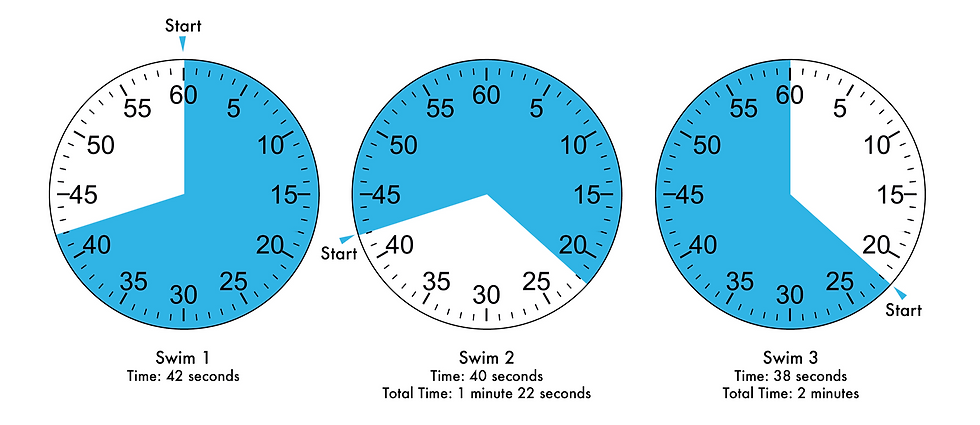
During a coach-led warm-up, practise over 150m: six lengths in a 25m pool.
Start on red :00. At 50m and 100m, touch turn, glance at the clock and push off immediately. Finish at 150m.
50m section | Focus | Split | Red hand | Total time |
First | Controlled | 0:42 | :42 | 0:42 |
Second | Build pace | 0:40 | :22 | 1:22 |
Third | Strong finish | 0:38 | :00 | 2:00 |
A split is the time for one part of the swim. Here, the splits are 42s, 40s and 38s.
At 100m, :22 is not a 22s split. One minute has elapsed:
1:22 minus 0:42 = 0:40 for the second 50m.
These are example times, not targets for every swimmer. With experience, swimmers learn to calculate and remember their splits while continuing to swim.
What Is a Cycle Time?
A cycle time includes the swim and the rest before starting again.
On a 60s cycle, a 42s swim leaves 18s rest. A 45s swim leaves 15s rest. Each start is still 60s after the previous one.
Lane Gaps: Getting It Right
Swimmers set off one at a time. Coaches choose the gap according to swimmer numbers, relative speeds and the set.
Typical examples are:
25m pool with around 4 swimmers: 10s gaps.
25m pool with 6–7 swimmers: 5s gaps.
50m pool with a larger training group: often 5s gaps.
A coach may shorten the gap if a fast leader risks catching the last swimmer after turning. Lane order matters too.
Lane leaders should communicate the starts and gaps. Everyone should still check the clock themselves and practise leading when appropriate.
Timing the Push-Off
Your start time is when your feet leave the wall, so prepare before the hand reaches that number.
At Bluefins, we teach Set, Drop, Lock, Push (SDLP).
Set: Hold the wall with one hand and that arm straight. Place both feet on the wall with your legs bent and knees pointing diagonally upwards at around 45°. This allows you to prepare for either a face-down push-off on your front or a face-up push-off on your back.
Drop: Begin lowering beneath the surface 1–2s before your target start time. Release your hand and bring that arm forward, keeping your feet on the wall.
Lock: Bring your hands together and extend your arms into streamline with your head between them. Position your body for the required front or back push-off.
Push: Drive through your legs so your feet leave the wall on the target second. Maintain your streamline.
Lane Etiquette: Toe Tapping
Continuous toe tapping is distracting. Follow your coach’s passing instructions.
Where a single light tap is the agreed signal, use it once. Only pass mid-length when the centre is clear of oncoming swimmers and there is room to complete the pass. Otherwise, maintain space and reorder at the next start.
Correct lane order should reduce the need to pass, particularly on repeats of 100m or less. Developing swimmers may need help holding a steady pace rather than repeatedly speeding up and slowing down.
Why We Leave a Gap
Leaving early can put you close enough to get a tow from the swimmer ahead. This can reduce the effort needed to hold your pace.
Keep the agreed gap so you practise swimming at your own pace. The Performance guide explains the training implications in more detail.
Clock Challenge: Crash & Burn
Start with 50m freestyle on a 60s cycle. Reduce the cycle by 1s after each swim:
60s, 59s, 58s, 57s…
These are cycle lengths, not clock positions to start on. As each cycle shortens, the next start comes sooner.
The coach controls the starts and stopping point. Stop when you cannot make the cycle or maintain the required technique.
Some experienced swimmers may reach a 35s cycle. This is not a target for beginners.
Whistle-controlled starts help the group follow the changing cycles. Swimmers should still check the clock and remember their times.
Parent and Swimmer Guide
For swimmers: Remember your start, prepare your push-off and keep the agreed gap. Check your finish and ask for help with the calculation.
For parents: Try “Did you manage to work out one of your times?” Practising a few clock examples together can help without turning the conversation into a training review.
Swimmers develop these skills at different rates. Encourage understanding rather than treating clock competence as a one-off test.
Coach’s View: Know your pace. Know your cycle. Know why.
Written by Spencer Turner Head of Swimming, Basingstoke Bluefins Swimming Club


